The short answer: because he’s so good.
The long answer is that, unfortunately, when you’re trying to improve your stories by emulating the greats, an excellent storyteller can sometimes get in the way. Watch Obama tell how his presidential campaign acquired the rallying cry of “Fired up, ready to go,” and see what you think:
So, what did you think? If you’re like most people, your first thought was, “Wow, what a great story.”
And your second thought was probably, “I could never do that.”
It’s true: not everyone can speak so eloquently. You probably haven’t been gifted with Obama’s oratory prowess, and it can be intimidating to even consider someone who seems so naturally talented.
But it’s important not to confuse the qualities that make someone an exceptional storyteller (which may take decades to master) with the qualities that make something an exceptional story (which can be learned and put into place much more quickly).
The same story, in three sentences
Consider a deliberately unremarkable retelling:
Early in his campaign, Obama drove an hour and a half in the rain to attend an event that attracted only 20 people. He was discouraged. A woman started an enthusiastic chant, which gradually lifted his spirits. That chant eventually became a rallying cry for his presidential campaign.
Even in this stripped-down version, something interesting happens: a man arrives in one state, and leaves in another. It’s Obama’s feelings, and how his feelings change over time, which create the basis for empathy and rapport from his audience, and make his story interesting. Notice, too, that Obama could have told us about a time when he inspired a room full of people. Instead, he tells us about a time when someone in a room full of people inspired him. It’s a humble and effective leadership move, showing us how he’s the beneficiary of someone else’s unexpected leadership.
A storyteller with incredible emotional range
Let’s take another, shorter example, from a very different situation, getting across a very different message:
Here’s the transcript, if you want to take a closer look:
In those awful moments after the South Tower was hit, some of the injured huddled in the wreckage of the 78th floor. The fires were spreading. The air was filled with smoke. It was dark, and they could barely see. It seemed as if there was no way out.
And then there came a voice -- clear, calm, saying he had found the stairs. A young man in his 20s, strong, emerged from the smoke, and over his nose and his mouth he wore a red handkerchief.
He called for fire extinguishers to fight back the flames. He tended to the wounded. He led those survivors down the stairs to safety, and carried a woman on his shoulders down 17 flights. Then he went back. Back up all those flights. Then back down again, bringing more wounded to safety. Until that moment when the tower fell.
They didn’t know his name. They didn’t know where he came from. But they knew their lives had been saved by the man in the red bandana.
In just 172 words, Obama sets the tone for the rest of his speech. It’s a much different tone, obviously, than the “Fired up, ready to go!” story, but it shows the same masterful treatment of the material, delivered respectfully, as well as his command of the room and his impeccable pacing (here, we have solemn pauses instead of comic timing). He also lets a physical object do some of the storytelling work for him. He also returned to it, at the end of his speech, to give it another, poignant perspective.
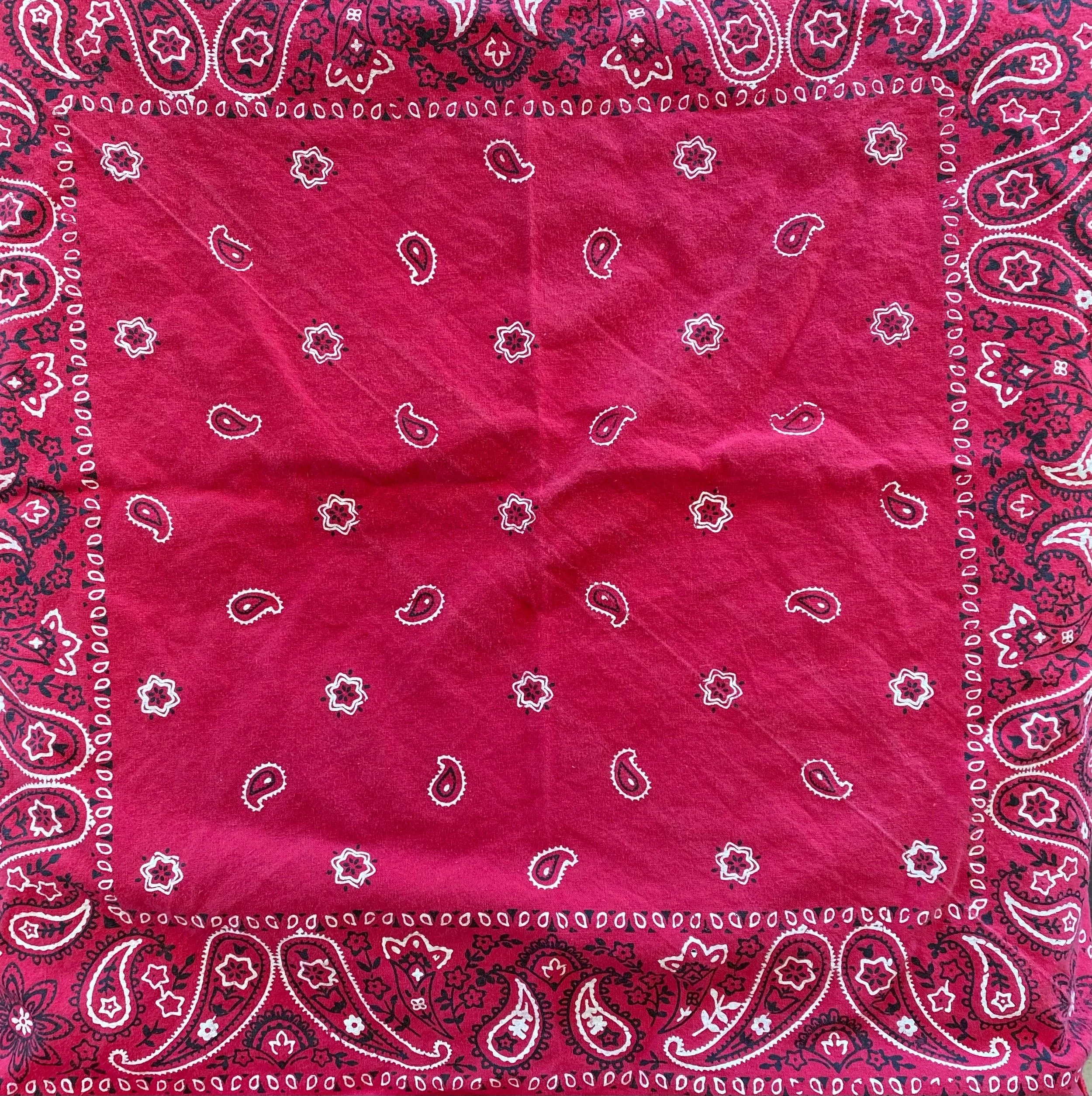
A red paisley bandanna, like the kind worn by Welles Crowther.
Months after losing her son, Alison Crowther was reading a newspaper article in which survivors described the man who had rescued them. When they mentioned the red handkerchief, she knew it had been her son, Welles, who had carried one since childhood. The red bandanna is a means of protection, a distinguishing feature, a clue to the man’s identity, a connection to his childhood, and, ultimately, a museum artifact (currently on display at the 9/11 Museum) through which future generations can learn his story.
Simple, elegant, respectful technique
There are some other important decisions to notice in this story. Obama withholds the young man’s identity—he could have introduced us to Welles Crowther at the beginning, provided some biographical information, and then explained what he did on September 11. Instead, he allows us to discover who Crowther was, much as the survivors, and ultimately his mother, came to understand his role in the rescue.
Finally, there is the matter of restraint. Obama doesn’t need to go on at length about Welles Crowther’s selfless courage. The haunting image of a man descending the stairs of a burning building, then turning around and going back up, communicates more than any string of adjectives ever could.
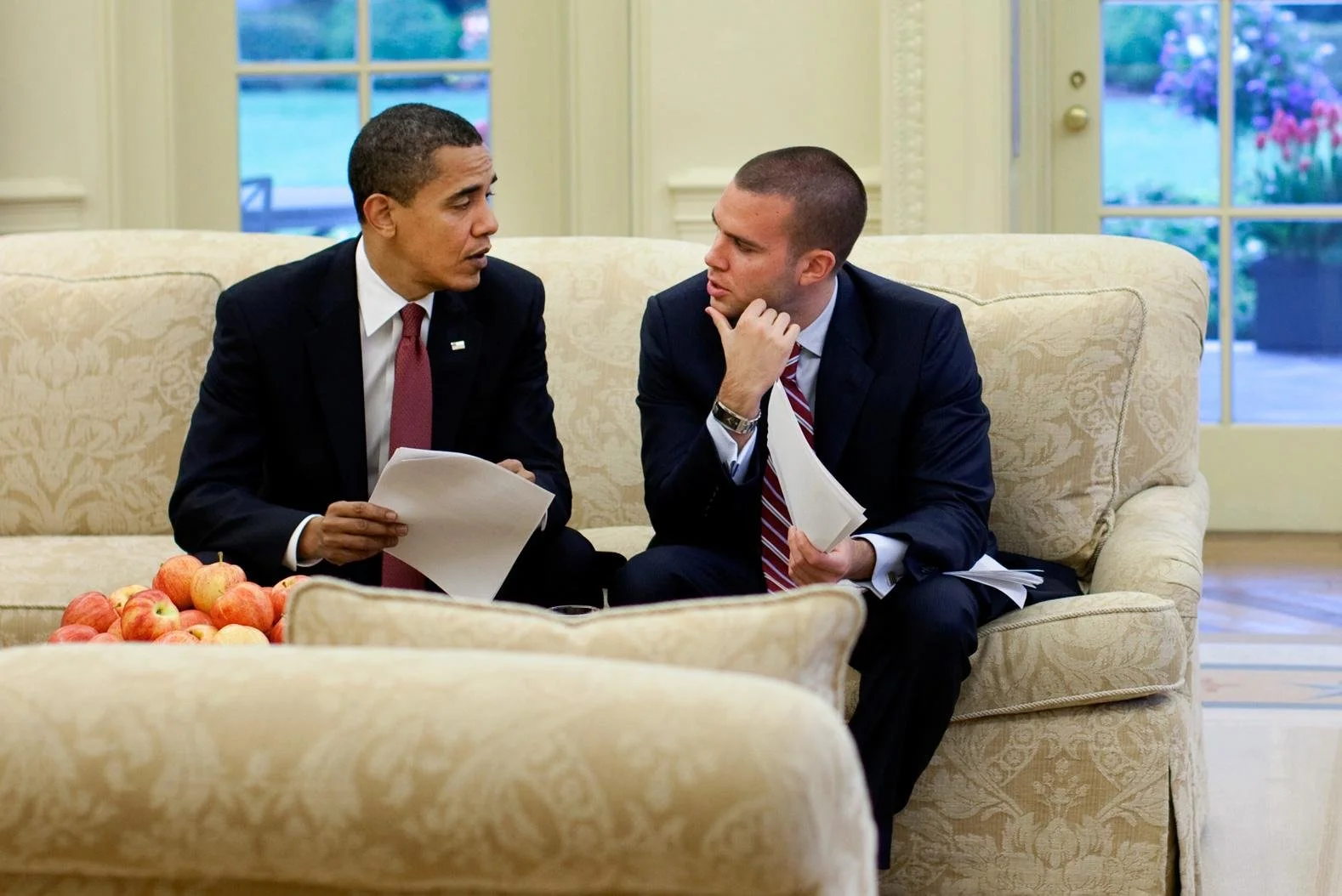
Barack Obama reviews a speech with his chief speechwriter, Jon Favreau, in the Oval Office. Photo: Pete Souza / White House, April 2009.
Study the story and the storyteller
Here’s a simple exercise for anyone interested in learning from a storyteller like Obama.
Watch one of his many famous stories on video. Then read the transcript. Finally, try summarizing the story in just a few plain sentences (as you can see above), and ask yourself: What survives?
In the Edith Childs story, it’s the transformation of a discouraged presidential candidate by an enthusiastic stranger.
In the Welles Crowther story, it’s a red handkerchief that allows a mother to discover what her son did in the final moments of his life.
In the Ashley Baia story, it’s an unexpected expression of solidarity. In the Ann Nixon Cooper story, it’s the contrast between the circumstances of a woman’s birth and those in which she casts her ballot 106 years later. And in this back-to-school address, it’s a little boy struggling with something that millions of other little boys and girls struggle with.
All of these stories benefit tremendously from Obama’s delivery, of course. But none of them depends on it entirely.
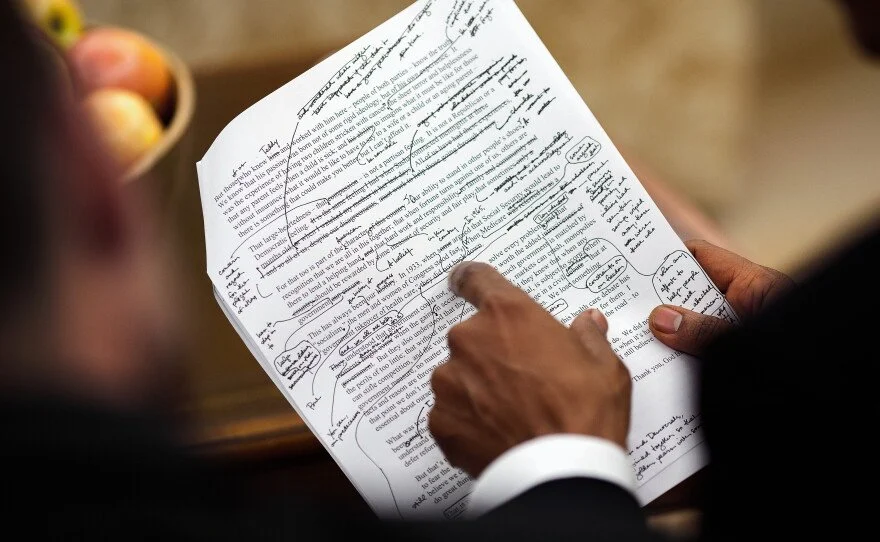
The craft behind the performance: a speech draft covered in Barack Obama’s handwritten revisions. Photo: Pete Souza / White House, September 2009.
And the decisions that make them effective—whether that’s finding a transformation, selecting a meaningful detail, withholding a piece of information, recognizing the significance of a line of dialogue, or finding the right human perspective—are decisions that any of us can learn to make.
We can appreciate a beautifully executed performance, while also recognizing that a great deal of the storytelling work took place before the storyteller stepped onstage.
The good news is that you don’t need to be Barack Obama to do that work.