“It’s not X, it’s Y” has become one of the most recognizable signatures of AI-generated prose. How can you learn to separate illuminating contrasts from empty rhetorical flourishes?

It’s not a helpful advertisement, it’s a useless tease. Dorothea Lange, Toward Los Angeles, California, 1937.
The food company Bonduelle once announced a line of ready-to-eat lunch bowls, with four new flavours, microwave-safe packaging, and a quote from the CEO:
“We’re not just launching a product – we’re launching a movement.”
Leaving aside the excitement of the lunch-bowl movement, you can probably recognize one of the most common constructions in AI-assisted writing: It's not X, it’s Y.
We’re not selling software; we’re transforming the future of work. It’s not about productivity; it’s about possibility. We’re not just a company; we’re a community . . . and on and on.
For many people, “It’s not X, it’s Y” has become an annoying “tell” of AI slop, yet some of the greatest storytellers in history have used it to extraordinary effect—and you might, too, once you understand how to do it well.
When everything is a reframe, nothing is
The brilliant Hollis Robbins offers a compelling explanation for why this construction can become so irritating.
Consider Otter.ai saying that “it wasn’t talking about the future of AI; it was building it.”
If people had been accusing Otter of cheap talk, or if the company wanted to distinguish itself from competitors who had made ambitious promises but delivered little, then the contrast works. Otherwise, why introduce the idea of talking about the future?
When the educational consultancy School First argues that the right school isn’t necessarily the highest-ranked school but the one that best fits your child, it’s a potentially excellent contrast—if it addresses a recognizable belief, and proposes a different criterion for making a decision about your child’s education.
Robbins says that “It’s not X, it’s Y” is a linguistic detour that imposes a cognitive cost. (Before learning what something is, readers must first entertain what it isn’t.) There’s also a social cost, because the formulation positions readers as people who need correcting, even when they’ve made no mistake.
Sometimes, of course, we do need correcting. Sometimes, the rejected idea is precisely what makes the replacement meaningful, and sometimes you can use the contrast to achieve something remarkable.
These constructions belong to a larger family of rhetorical devices that correct, qualify, escalate, and reverse. They share a dependence on the relationship between two ideas, and their success depends less on the elegance of their individual halves than on the quality of the relationship between them.
Let’s take a look at some masters at work.

It’s not a feather or a smudge in the foreground, it’s a sideways stretched skull. Hans Holbein the Younger, The Ambassadors, 1533.
Contrast can correct—and then move, surprise, and amuse us
Consider a line from Dostoevsky’s The Brothers Karamazov:
“Othello was not jealous, he was trustful.”
It’s a striking reinterpretation of one of literature’s most famous characters, and Dostoevsky goes on to say that Othello’s tragedy comes from the destruction of his trust, whereas a truly jealous man lives in a perpetual state of suspicion.
Here, the contrast becomes an original psychological argument, one that changes how we understand jealousy itself.
Writing about John Milton’s mastery of Latin, the nineteenth-century historian and essayist Thomas Babington Macaulay observes:
“But he writes with as much ease and freedom as if Latin were his mother tongue; and, where he is least happy, his failure seems to arise from the carelessness of a native, not from the ignorance of a foreigner.”
In Macaulay’s eyes, even Milton’s mistakes testify to his mastery. Without that contrast, we would lose the rich distinction between the kinds of mistakes made by people who know a language intimately and those made by people who are still learning it.

It’s not just any old sequoia, it’s the Grizzly Sequoia. Carleton Watkins, The Grizzly Giant, Mariposa Grove, c. 1861.
In his beautiful poem “Planting a Sequoia,” Dana Gioia describes an old custom:
In Sicily a father plants a tree to celebrate his first son’s birth–
An olive or a fig tree–a sign that the earth has one more life to bear.
In the following stanza comes a devastating reversal:
But today we kneel in the cold planting you, our native giant,
Defying the practical custom of our fathers
Gioia is planting a tree for his son, too, but the child has died. Without the preceding description of the Sicilian tradition, the act of planting the tree would still be moving. With it, however, we feel the tragic discrepancy between the life Gioia had imagined—for his son, and for himself.
James Salter covers similar territory in a single sentence in his memoir Burning the Days:
“The death of kings can be recited, but not of one’s child.”
Of course, in professional communication, we’re generally not writing literature. Although there’s a great deal we can learn from the literary masters, and it can be gratifying to see them at work, at some point we have to ask: what particular risks does the habitual use of contrast present for us in our everyday writing?
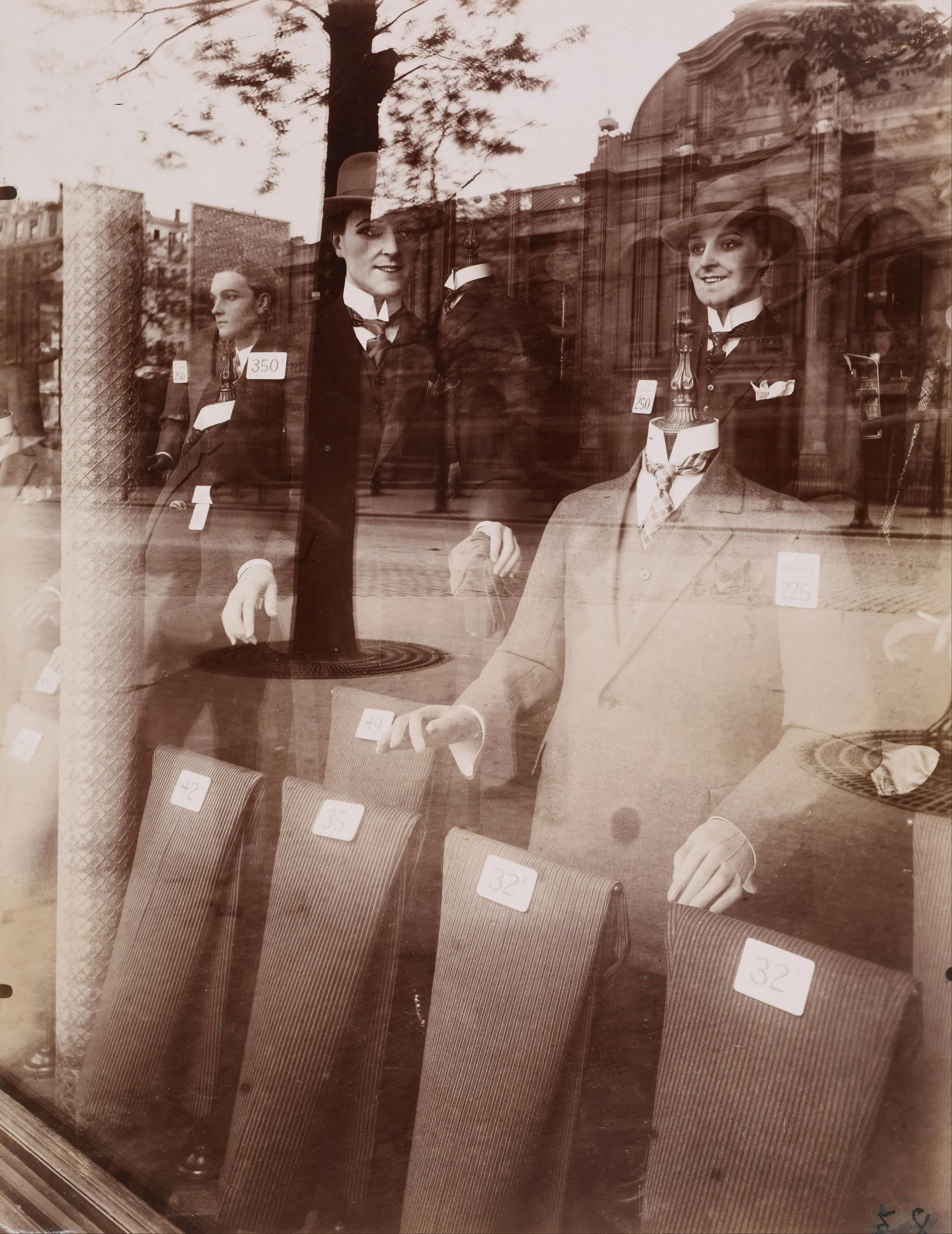
It’s not formalwear for sale, it’s the Manufacture des Gobelins. Eugène Atget, Magasin, Avenue des Gobelins, 1925.
Four questions for your contrast
The next time you write your own “not X, but Y” sentence, ask yourself:
1. Is X worth introducing? Does it establish a genuine misconception, expectation, assumption, or point of comparison? Dostoevsky has a reason to challenge our interpretation of Othello. Does your sentence have a comparable reason for challenging its reader?
2. Is the relationship between X and Y meaningful? The replacement should clarify something specific, not simply elevate an ordinary idea into a grander abstraction. Words have meanings, as Jerry Seinfeld reminds us. Beware of turning every product into a movement and every service into a transformation.
3. What does the reader gain from the contrast? It might provide a new understanding, an unexpected emotional reversal, or even a joke. Gioia’s poem and Beckett’s prose succeed for different reasons, but both make the reader’s effort worthwhile.
4. What would we lose by removing X? Try deleting the first half and reading what remains. (If you haven’t lost anything important, you probably don’t need it.)
For instance, you might begin with:
“Our training isn’t just about teaching employees new skills. It’s about empowering them to succeed in a changing world.”
As a first revision, you might delete the contrast:
“Our training empowers employees to succeed in a changing world.”
That’s shorter, though still generic. A second revision might focus on the substance beneath the abstractions:
“Participants leave the workshop with three techniques they can use in their next presentation.”
Now we have a concrete promise that tells the reader something useful. (It’s not poetry, but it doesn’t have to be.) It’s remarkable what you can accomplish by working carefully at the level of the sentence.
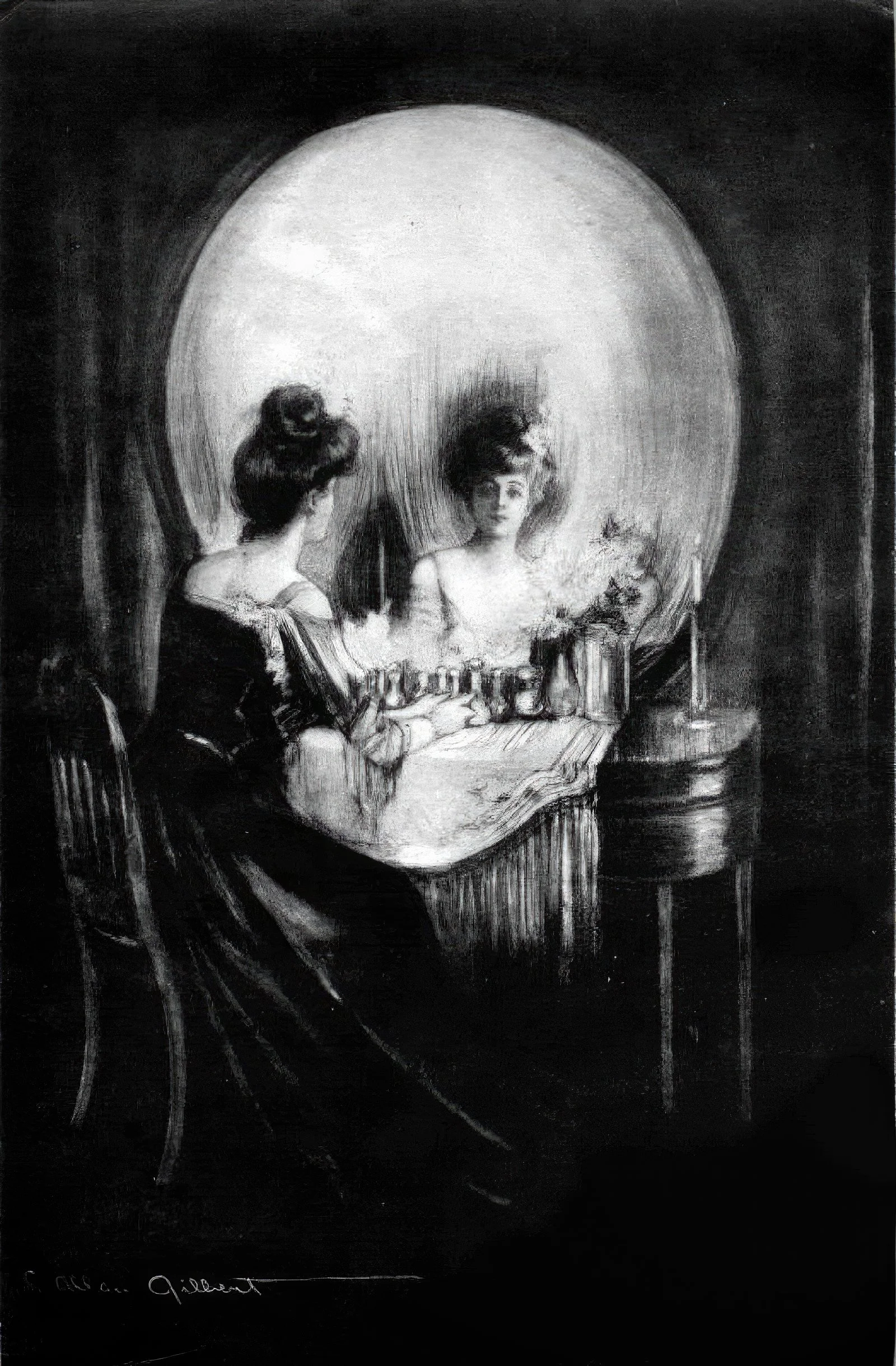
It’s not an ominous skull, it’s a lady getting ready for a night out on the town. Charles Allan Gilbert, All Is Vanity, 1892.
Sounding insightful vs. being insightful
“It’s not X, it’s Y” can be a seductive construction, but you want to be careful about being persistently tidy in your writing. Presenting your audiences an artificial choice between two ideas that are neither mutually exclusive nor particularly opposed is merely lazy. “We’re not interested in profits; we’re interested in people. It’s not about efficiency; it’s about innovation.” Okay, but is this really the most efficient way to say what we’re trying to get across?
Beware of the ability to give unresolved questions the appearance of having been resolved. By offering two ideas as alternatives, dismissing one, and elevating the other, you can create the satisfying architecture of an argument while leaving your audience unsatisfied, or even puzzled.
(This problem long predates AI, by the way. Even one of the most successful sales letters in advertising history builds its persuasive power around a compelling contrast that doesn’t entirely hold up.)
In A Swim in a Pond in the Rain, George Saunders writes:
“But the true beauty of a story is not in its apparent conclusion but in the alteration in the mind of the reader that has occurred along the way.”
That’s a useful standard for any kind of communication.
Dostoevsky changes how we understand jealousy, Gioia transforms an ancient celebration of birth into an elegy for a child, Beckett makes us laugh at an absurdly conscientious clarification, and you too can communicate just as powerfully—even if your message is about lunch bowls.